
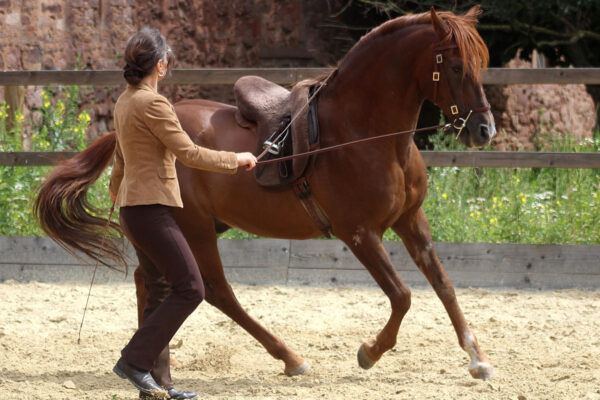
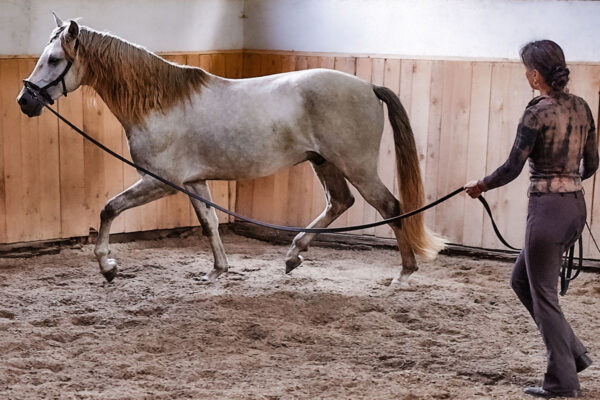
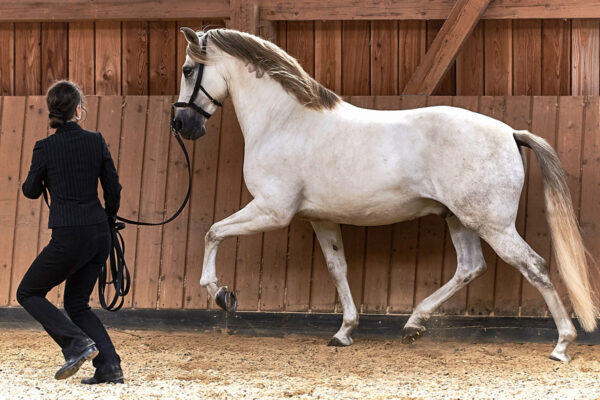
Balance
Relaxation
Mobility
Strength and Elasticity

Balance
Relaxation
Mobility
Strength & Elasticity

Balance
Relaxation
Mobility
Strength & Elasticity

“Riding in lightness is not a matter of taste, but a question of meeting certain criteria that are essential to keeping the horse’s body fully functional.” Sonja Weber

Trainer Training
From the Basics
up to Haute École

Trainer Training
From the Basics up to Haute École

The interest in horse-centred and individually tailored training is steadily growing – as is the demand for qualified instruction and well-founded training of horses. As I have been unable to fully meet this demand for some time due to capacity constraints, my current focus lies on the education of trainers. I subsequently recommend these trainers so that the principles of refined, horse-centred work can be passed on sustainably.

The trainer education is aimed at advanced riders who wish to enter the professional field of training horses and riders, or who are already active as instructors and seek to deepen their expertise on a solid professional foundation.

For training content to be truly adaptable to each individual horse, a deep understanding of the underlying principles is required. Traditional curricula often tend to simplify and standardise content in order to make it more easily teachable. However, this frequently leads to a loss of quality and individuality.

At the core of this education are therefore fundamental parameters such as:

  • Balance
  • Relaxation
  • Suppleness and mobility
  • Activity
  • Stability, strength and elasticity

Exercises and lessons do not follow a fixed sequence but are adapted flexibly to the individual horse, its level of training, and the current situation. This ensures that the work remains individual, dynamic, high in quality, and consistently horse-centred (“equizentred”). I currently offer the following training programme:

Individual Trainer Training (one-to-one setting) – available in English

For English-speaking riders, the programme is offered exclusively online, allowing you to benefit from personalised instruction wherever you are in the world.

The training follows a flexible format, with the duration tailored to individual needs. For German-speaking participants, it can take place online and/or on-site. Examination dates are arranged individually.

Here you can learn more about the content:

Here you can learn more about the content of the training pathways:

Due to capacity constraints, I currently do not offer off-site courses, off-site instruction, full livery training, or school horses.

Individual Trainer Training
One-to-One Setting

Individual Trainer Training
One-to-One Setting

The individual trainer education is available in English and includes the following components:

  • Individual instruction with the participant’s own horse: work in-hand, on the lunge, in free work, and under saddle
  • Joint case analysis: developing initial training approaches based on concrete horse and/or rider examples
  • Development of a structured concept for starting young horses under saddle
  • Theoretical instruction: based on my teaching films on the theory of collection and its practical application
  • Learning to teach: supervised instruction with the participants’ own students
  • Individually tailored assessments: throughout the entire training period, including a final examination with certification at different levels

Exchange & Collaborative Learning:

  • Collaborative Learning: Upon request, participants in the individual trainer programme can connect with other participants for shared learning and professional exchange.
  • Online Theory Sessions: Joint sessions provide an opportunity to deepen and discuss training content, as well as to analyse images, videos and specific teaching situations.
  • Insights into Other Training Processes: By mutual agreement, participants may observe other participants’ lessons, gaining insights into different horses, levels of training, challenges and approaches to finding solutions.
  • Professional Exchange: Joint reflection complements the individual training and encourages a differentiated and reflective understanding of horse training and teaching.

Get started with our inquiry form. After your initial non-binding inquiry, we will provide you with further information about fees, the program details, and the application process.

For information regarding costs, programme structure, and applications, please send an email including your full contact details and the desired training format:

Find a Trainer – If you are looking for a trainer for yourself and your horse, you can find a suitable trainer here – or choose individual online lessons.

Inquiry Form

Here you can select your preferred training option and submit a non-binding inquiry regarding the Trainer Training Program. Once you have submitted the form, you will receive further information about fees, the course structure, and the application process.

As places are limited, I kindly ask that you submit an inquiry only if you have a genuine interest in the program. All information requested is mandatory and must be provided in full.

Formular Trainerausbildung EN (#3)

This form is protected by Cloudflare Turnstile to prevent automated submissions. For more information, please refer to our Privacy Policy.

“Training must only ever refine and perfect nature. If it violates nature in the slightest, she is irretrievably lost.”
Brigadier Kurt Albrecht

Horse-centric
the horse at the core
of all decisions

Lusitano Marialva, 25 years old, school gallop in work at hand

Accompaniment of horse and rider

According to the principle of working in a “horse-centric” way, the needs and requirements of the horse have to be at the core of all decisions. The horse is at out mercy; we are responsible for its well-being. If an aim set by the rider or demanded by a dressage competition is harmful to the horse, this is a far cry from meaningful training. I offer to accompany riders who set great store by training and advancing their horses in positive ways.

While schooling a horse, we cannot explain to it that what we are doing in this particular moment chiefly concerns the rider. This is why I always try to adapt the training to the concerns of the horse, so that it is not disturbed by the learning situation of its rider. Of course, this does not mean that the rider does not get the space they need to learn; in the long run, the progress of the rider is essential to the well-being of both horse and rider.

Lusitano Finito, aged 4 years, at the beginning of his schooling:
His muscles are flat, and he moves in a horizontal and thrusting manner, pushing forward. This becomes apparent in how he keeps his neck as well as his ribcage quite low, pushing his body over the forehand.

Lusitano Finito at the age of 9 after 5 years of schooling:
Particularly in the areas of the neck, the withers, the back and the croup he is strongly muscled. His movements incline towards the vertical and are characterised by an upwards thrust. His entire front is raised and he no longer pushes his body over the forehand.

What my
students say